Special Educational Needs (SEND)
What is SEND?
The UK Government SEND Code of Practice (https://www.gov.uk/government/publications/send-code-of-practice-0-to-25) states that ‘a child or young person has SEND (Special Educational Needs and Disabilities) if they have a learning difficulty or disability’ that calls for provision that is additional to, or different from that made generally for other children or young people of the same age by mainstream schools.
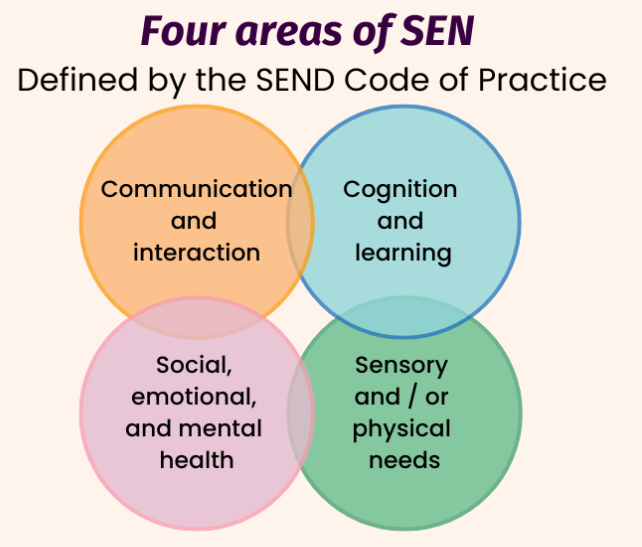
The SEND Code of Practice categorises learning difficulties into four key areas.
How do we support SEND learners?
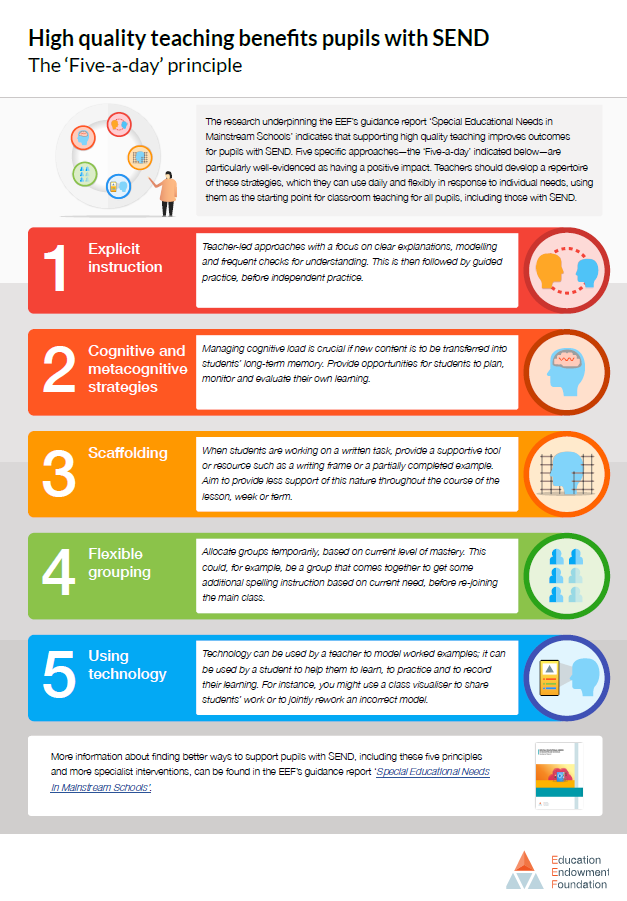
The Education Endowment Fund's research evidence suggests that there are five approaches - 'five a day' - that teachers should consider adopting for pupils with SEND. These five teaching approaches are likely to broadly support all pupils, while particularly supporting many pupils with SEND. We aim to follow these approaches at all times, namely:
- Explicit instruction - being clear using language children understand.
- Cognitive and metacognitive strategies - considering how children learn, how children can evaluate and consider their own learning.
- Scaffolding - providing the appropriate level of support for tasks so that children can feel successful.
- Flexible grouping - temporary grouping based on levels of understanding.
- Using technology - visualisers, speech to text, typing etc
Further information on our offer to support those children with SEND can be found within this suite of webpages.
In order to support children who may have a learning difficulty or disability that requires additional provision, and in line with best practice, the school maintains a SEND register - a list of children who are consistently age-related expecations, with learning disabilities or difficulties that require substantial interventions or adaptations throughout all subjects.
Whilst each class teacher is responsible for supporting pupils with SEND in their class, the school SENCO is responsible for managing the school's strategy for pupils with SEND, acting as a link between the school, parents and external agencies to ensure that children get the right levels of support, handling day-to-day SEND policy implementation, staff training and monitoring effectiveness of the SEND strategies.
The school's SENCO is currently Mrs Loomes (Headteacher).
What is the difference between vulnerable and SEND?
"Vulnerable" is a broad term describing a state of being at greater risk of harm or poor outcomes due to various life factors, while SEN (Special Educational Needs) refers to specific learning difficulties or disabilities that require special educational provision.