Science Focus Week - Investigating Pattern
At Woodchester, we love Science and this week the focus of our investigation and exploration was Pattern. A pattern is a particular way in which something is done, is organised or happens over time. We can see patterns in nature and in Art, they exist around us, e.g. patterns in snowflackes, leaves, flowers etc. This year during Woodchester Science Week, we investigated if patterns exist in Science. With 'bubbles' still in place, we couldn't mix up year groups as we usually do so instead each class investigated the same question on the same day.
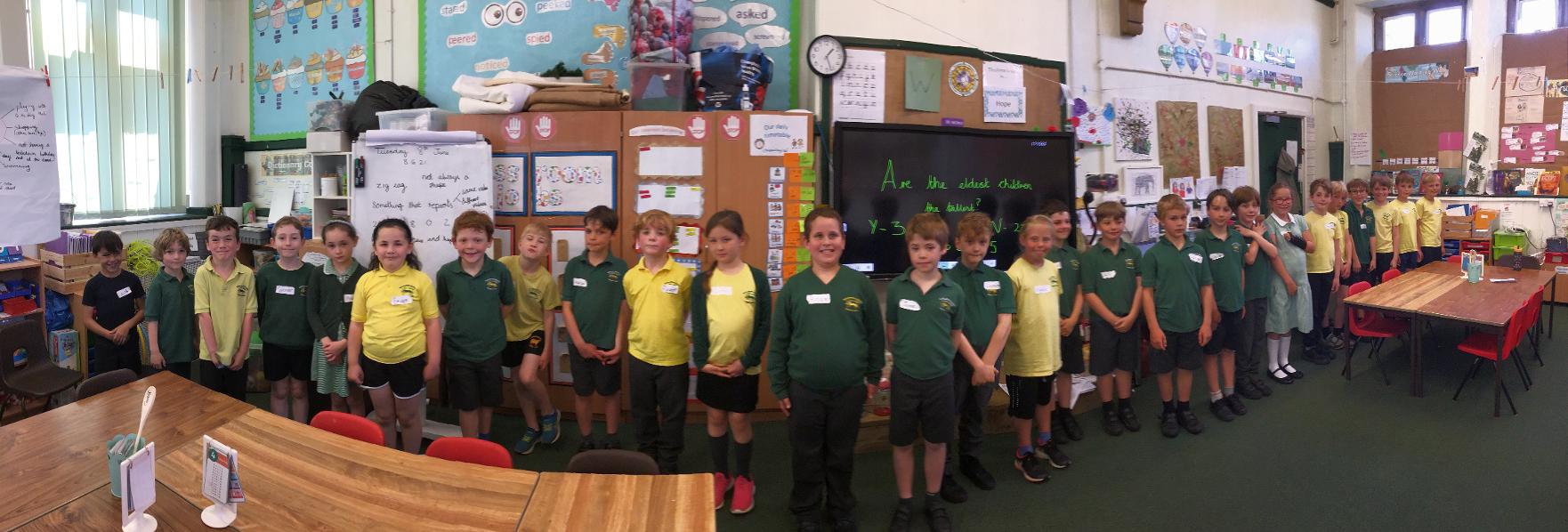
Day 1 - Are the eldest children in the class the tallest?
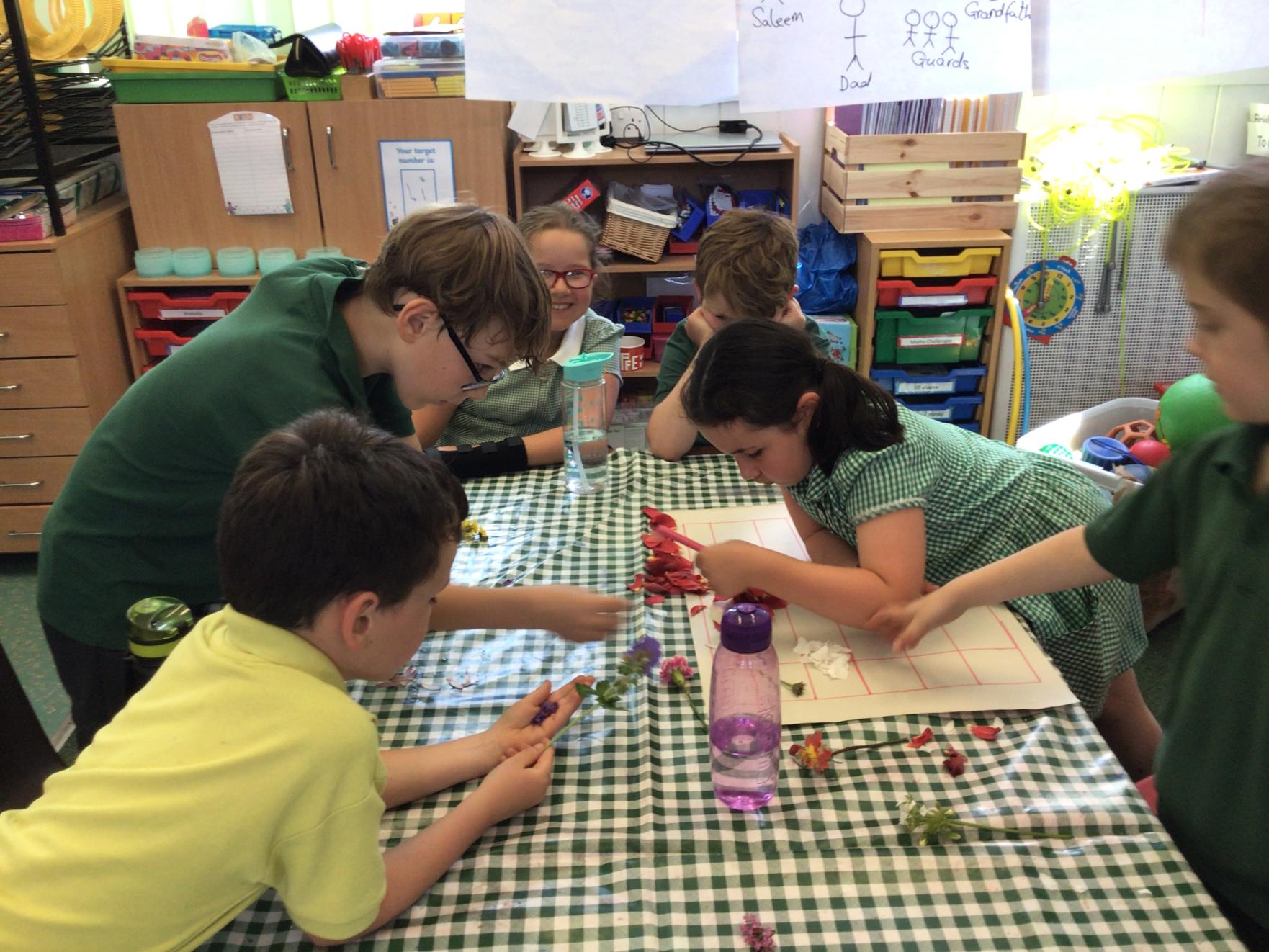
Day 2 - Do all flowers have the same number of petals?
Day 3 - Do longer legs run faster over a set distance?
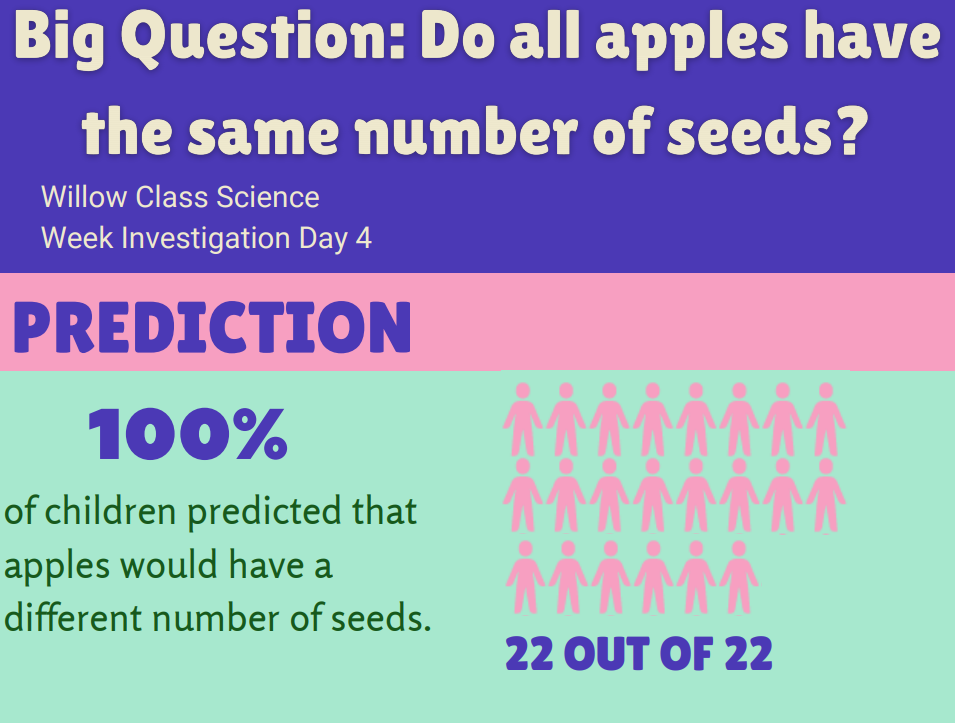
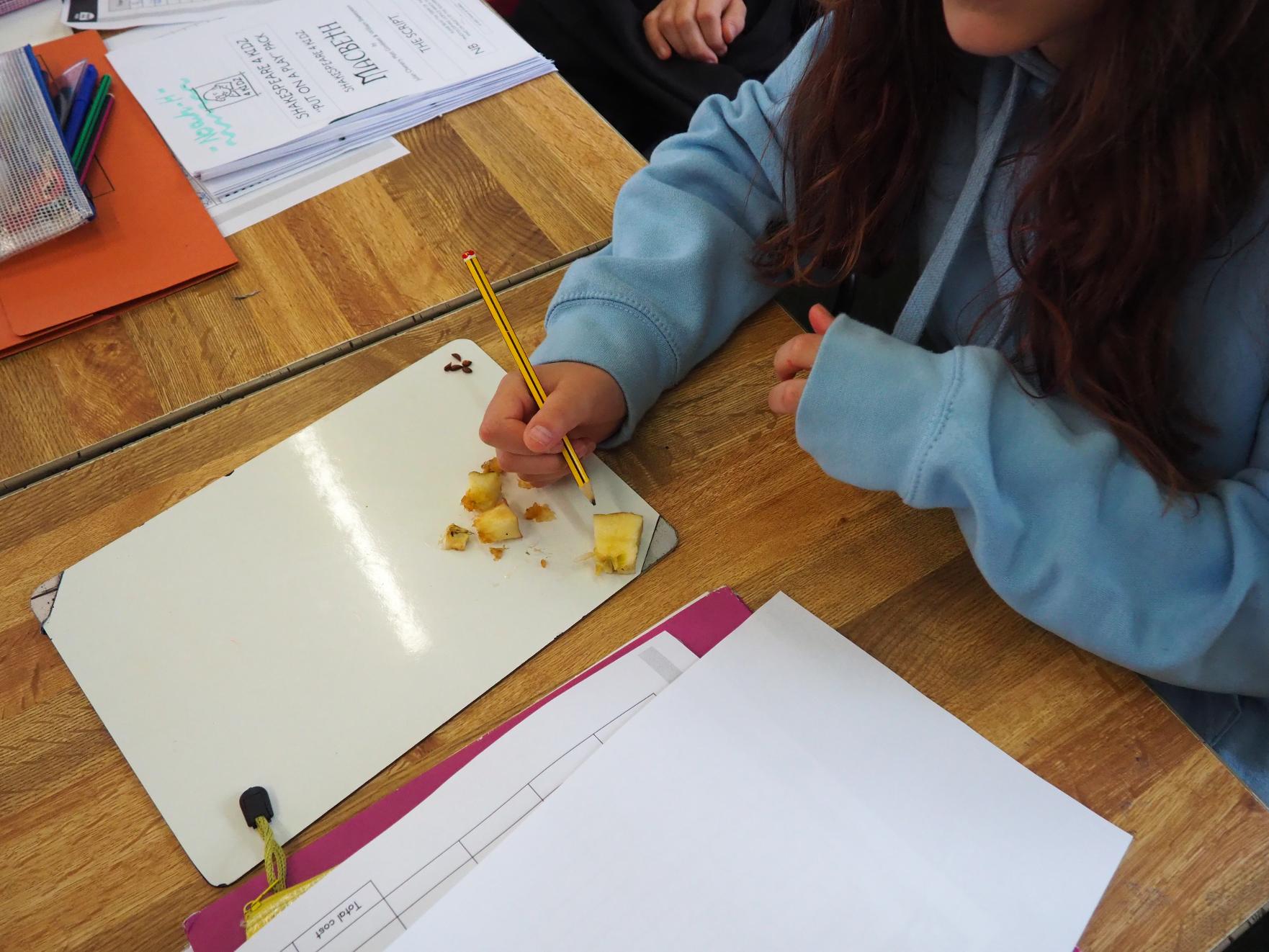
Day 4 - Do all apples have the same number of seeds?
Day 5 - Can bigger hands hold more?
Here are some of our findings as well as some photographs of the week.

Here is what some of our children thought about Science Focus Week.
|
Pupil |
Year group |
Opinion |
|
Dominic |
Reception |
The tallest question was my favourite. We measured people and I liked it. It didn’t feel like science. |
|
Edith |
Reception |
I really liked it when we looked at the apples. I took the seeds home to plant. I found 11 seeds with Clara. |
|
Daenerys |
1 |
My favourite was jumping the furthest. It didn’t feel like science and I jumped really far. |
|
Toby |
1 |
My favourite was investigating apples. I liked using the microscope – it made the seeds look a bit like honeycomb. |
|
Bo |
2 |
Counting the petals on the flowers was the best. There were lots of different colours. It was nice not putting things in the books. |
|
Thackerey |
2 |
It was fun finding out things I didn’t know. I thought the oldest would be the tallest but I was wrong. |
|
Adam |
3 |
It was all so exciting. It did feel like science but I liked not writing. My favourite was looking through the microscope at the apples. |
|
Grace |
4 |
I really liked all of the investigations. I liked how we had a question and then we all tried things to see if it was true. I liked looking at the apples and we thought that they would all have different seeds. |
|
Isabelle |
5 |
I’ve challenged my thinking when we looked at the apples. I thought that the same type of apples would have the same number of seeds but it was not true. We used magnifying glasses and saw the grooves on the pips. |
|
Oscar |
5 |
I really liked learning about the Fibonacci sequence. I never thought it could be so much fun using Maths and Science to look at flowers |
|
Monty |
6 |
I really liked the apples investigation – we looked at the insides through the microscopes which was fun. It looked very different to what I thought. |
|
Isabella |
6 |
My favourite was counting the flower petals. Whilst I thought different flowers would have different petals it was interesting to see the differences in real life. Even the same type of flowers had different numbers of petals which I wasn’t expecting. We talked about how the health of the plant may impact on the number of petals. |
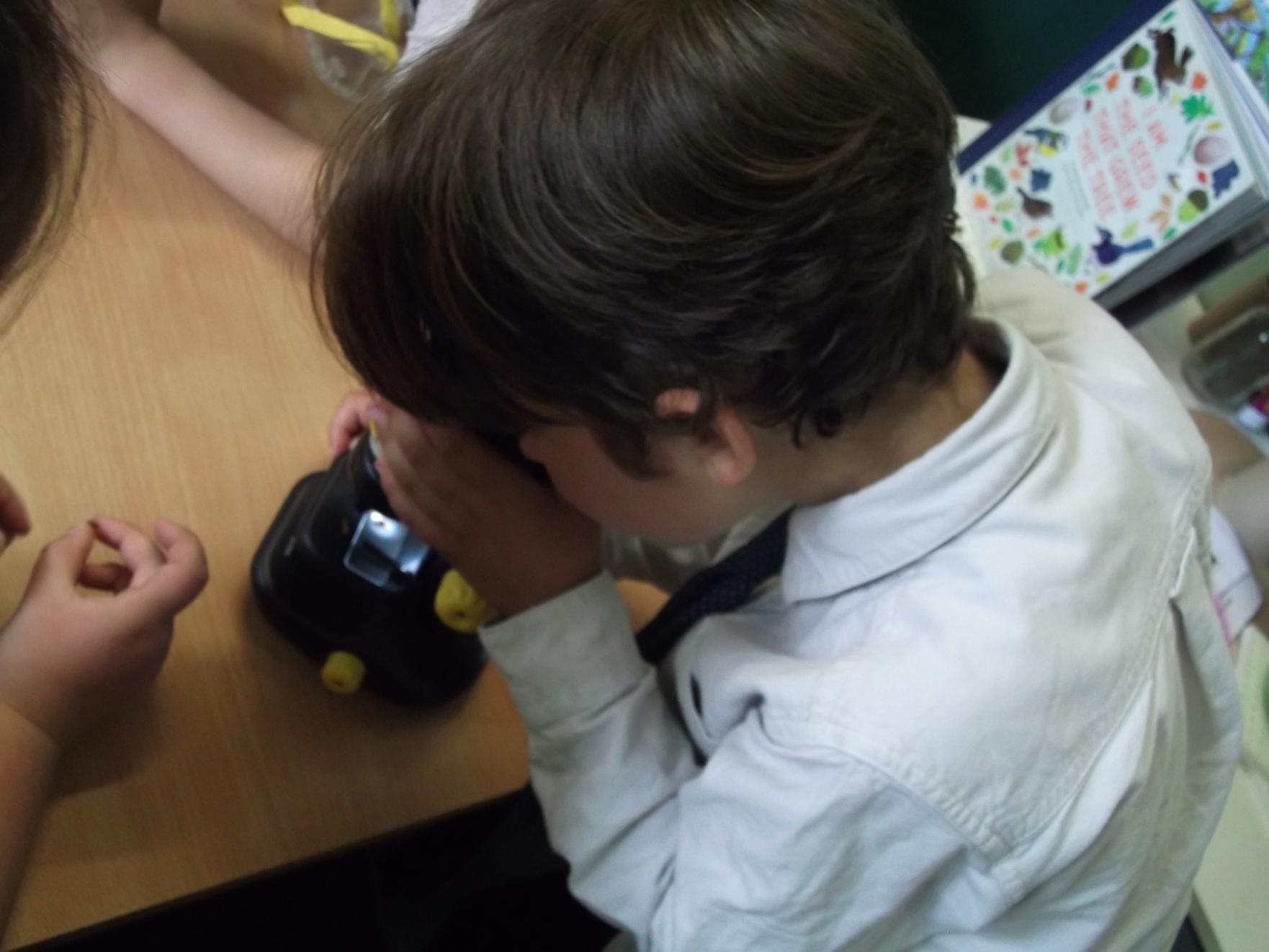

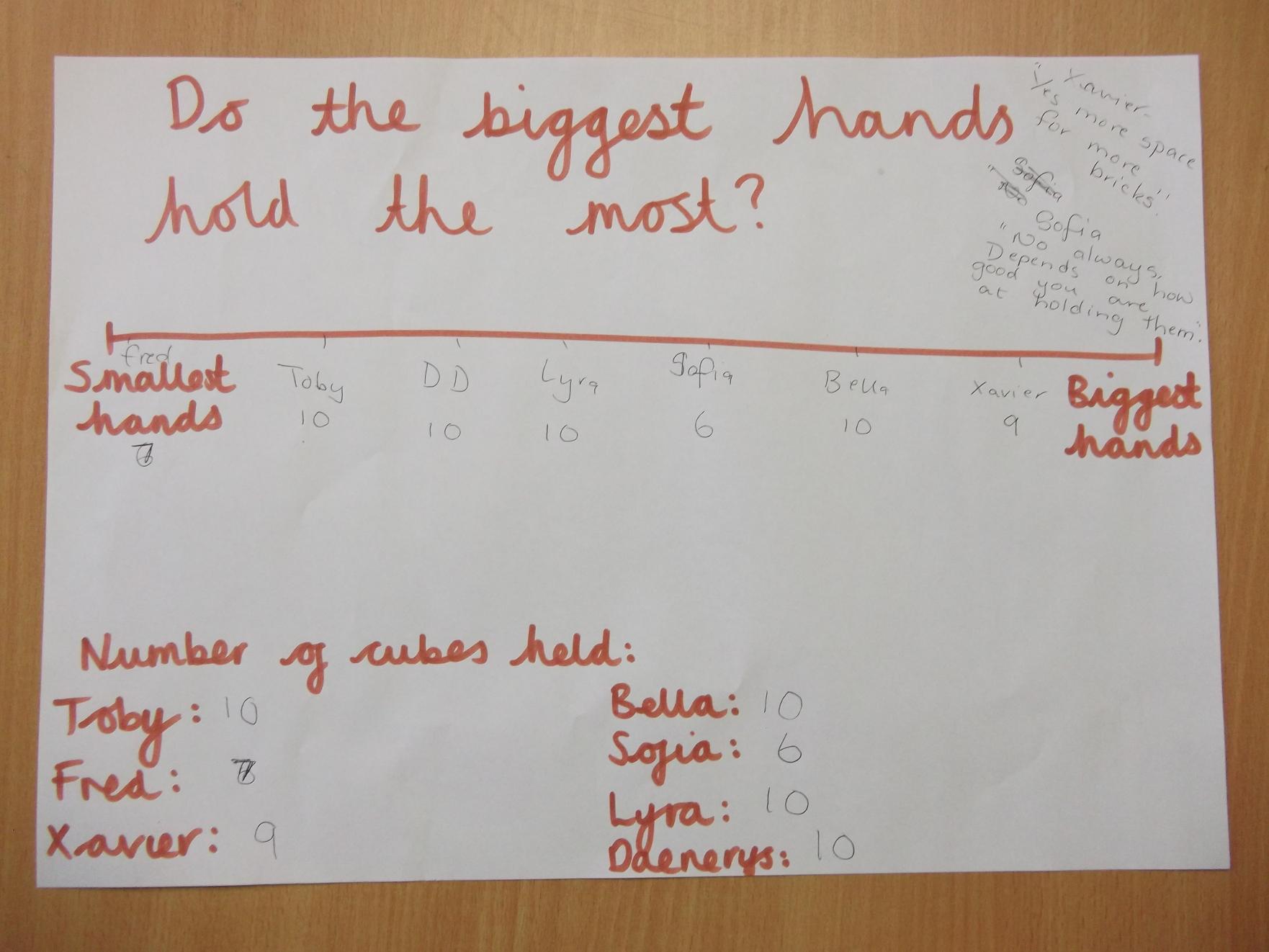




Can the biggest hands hold the most things?
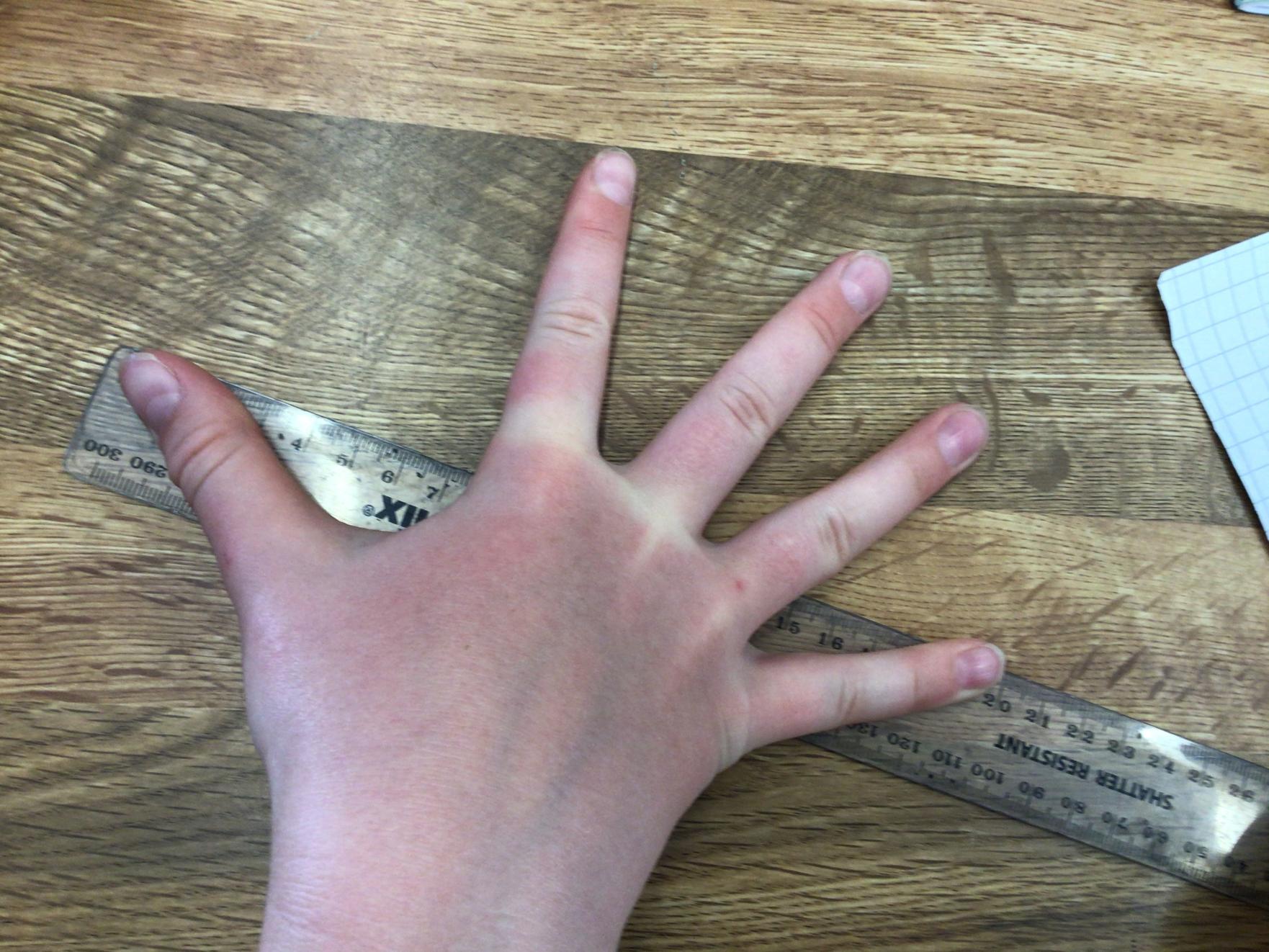
Ash - We talked about a fair test, and Mrs Holmes modelled using fire engines in one handful and sports cars in another and how this might be considered not fair.We needed an object that was exactly the same size, and someone suggested counters. We then talked about measuring our hands and we compared hand sizes. We asked the big question and invited predictions. We predicted that the largest hand would have the biggest grab of counters. The adults measured each hand from top of the palm to the top of the middle finger. The children then grabbed a handful of counters then counted them.
Conclusion: We looked at the information that we recorded. The four children with the largest hands were not the same as the four children with the biggest grab. We also noted that it was a developmental skill to be able to grab a good number ( two of our youngest members only grabbed 4 and 6 whereas one Y1 child grabbed 24)
Beech - We found today's investigation interesting as we found out that even if you had the biggest hands, you didn't always hold the most cubes! We decided to all pick up the same object (cubes) as that would make it a fair test. After looking at the results of our investigation, we pondered whether it made a difference as to how you grabbed the cubes or how well your hands could pick up the cubes, rather than the size of the hand. Did this have an effect on how many you could pick up?
Hawthorn – The class initially decided that yes the biggest hands could hold the most. They then had a go at picking up lots of things from glass pebbles to cubes to dice. We then talked about whether the shape of the object influenced how much could be held. This split opinion slightly until we showed that the smallest hands could hold the same amount of multi-link cubes as the biggest hands if they were joined together.
Hawthorn then agreed that sometimes the biggest hands could hold most but that it depended entirely on the size, weight and shape of the items being held.
Juniper The class decided that more than likely this was the case, but decided there could be some variables which could affect the result e.g shape of object, type of object and the material it is made from.
We chose to use small cubes to test our prediction.
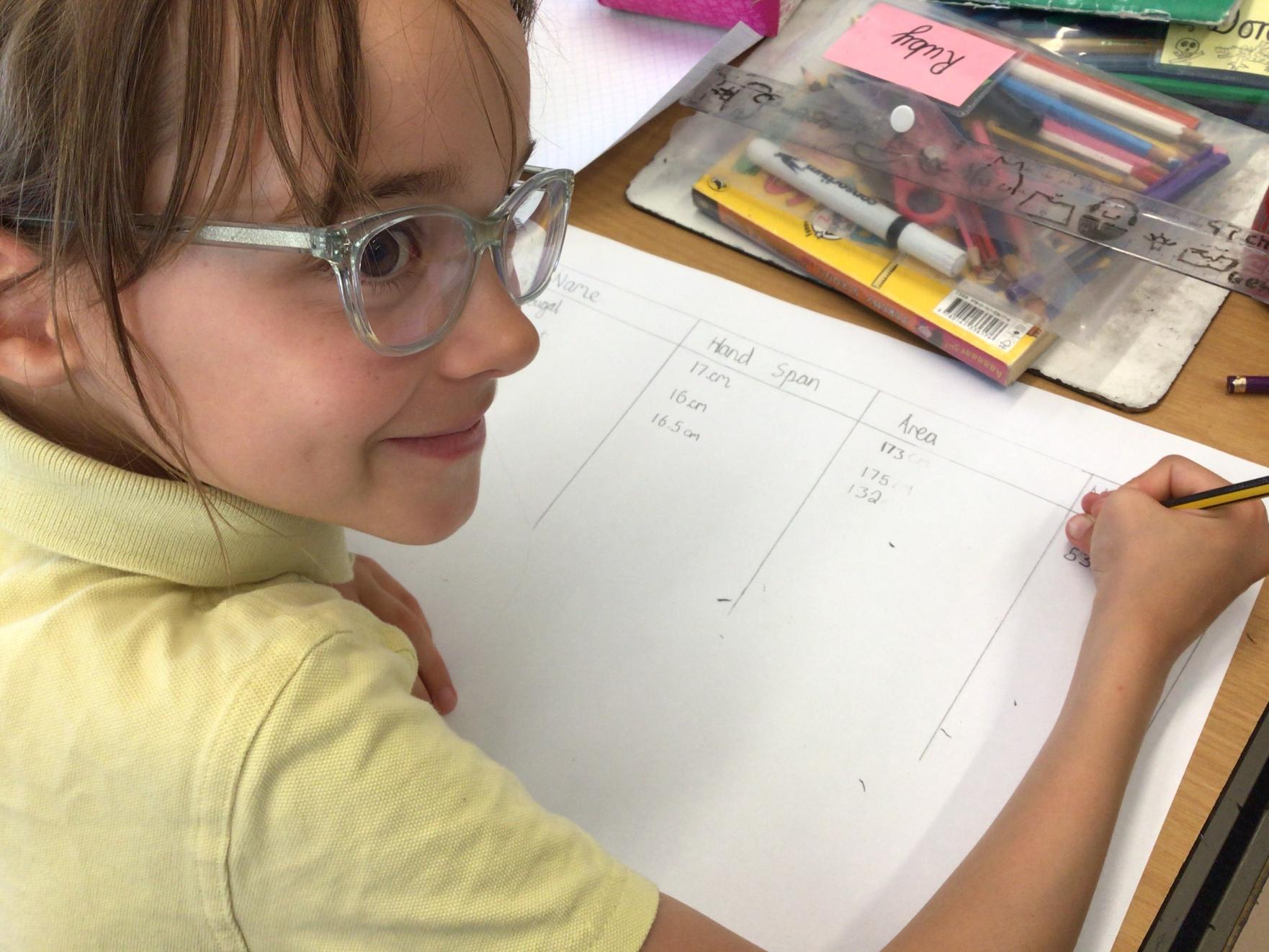
To discover the size of our hands, we measured our hand spans and used squared paper to work out the surface area of our hands. We completed charts in groups and then looked at our final results.
Results
The largest hand had a surface area of 146cm squares and was able to hold 95 cubes and the smallest hand was 90cm squares and was able to hold 85 cubes.
Conclusion
Our hypothesis was proved right, but not conclusive. Had there been more time, the class would have liked to have tested other objects.
Do all apples have the same number of pips?
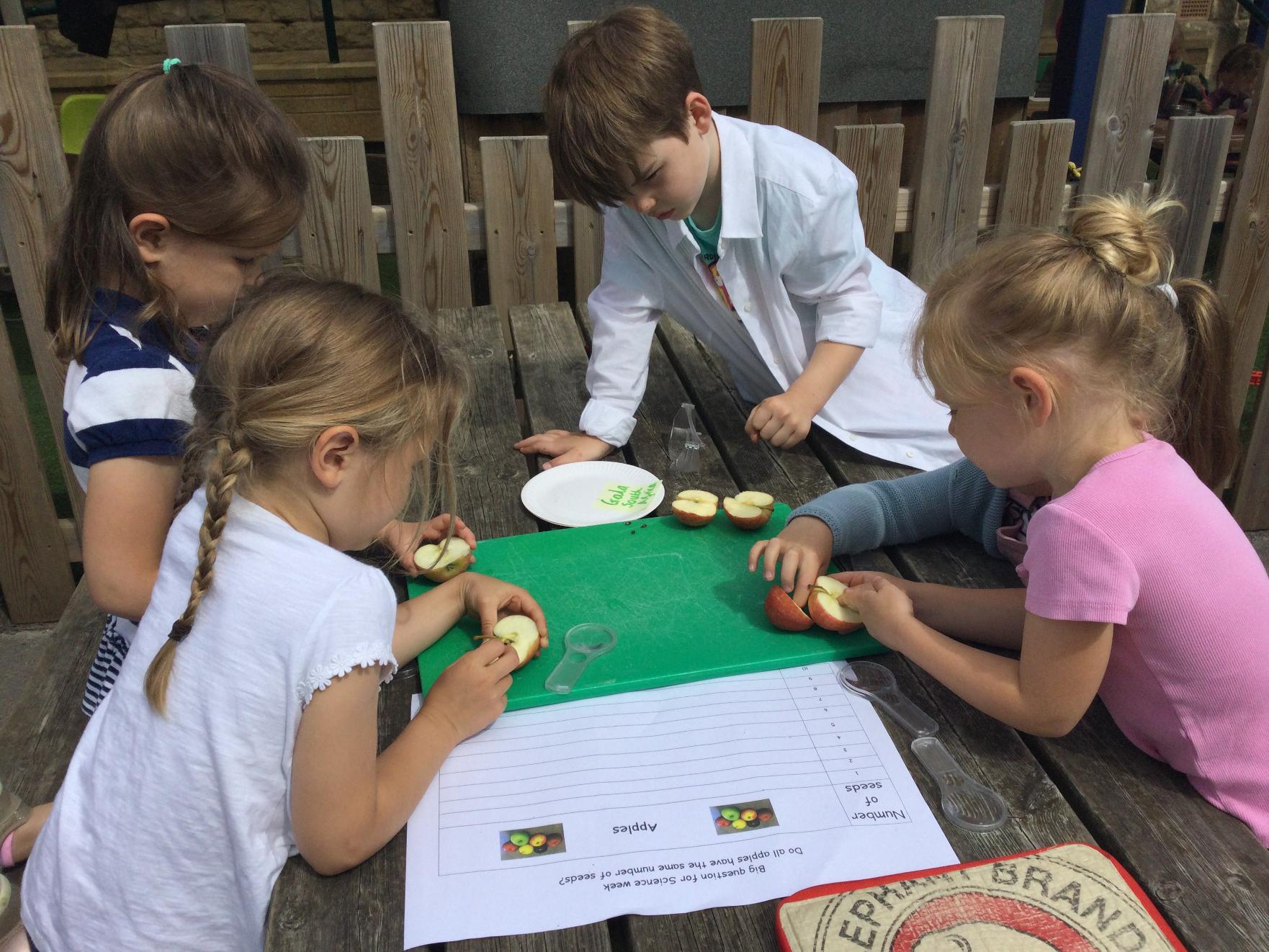
Ash - The general consensus was, ‘the bigger the apple, the more seeds would be found inside’.
It was interesting to discuss this with each group and also at the end with the whole class when we shared the chart. We were very surprised to discover that the smaller apples tended to have the higher number of seeds!
One observation from Layla was that because she thought most apples have around 6 or 7 seeds, then she thought this would be the same for this experiment. Indeed, 6 out of the 8 apples had 6 or more seeds inside!
When looking at the completed chart, Thomas said all the apples had 4 or more seeds. He said that there weren’t any apples with 1, 2 or 3 seeds. He was confused why smaller apples were full of seeds, (one of the Gala apples from South Africa, being the smallest variety of apple, had 11 seeds!) He said that the apples don’t need to keep all seeds if apples only need 4 to grow. This has prompted Mrs Holmes to investigate reasons behind the number of seeds found inside apples.
Quite a few of the children noticed, and were most intrigued by, a very dark looking, almost black apple on the picture I had included on the chart. Billy and Charlie thought that perhaps it was just a very dark red apple. I suggested I would try to find out if very dark red, or black apples exist and again share this with them the following week.
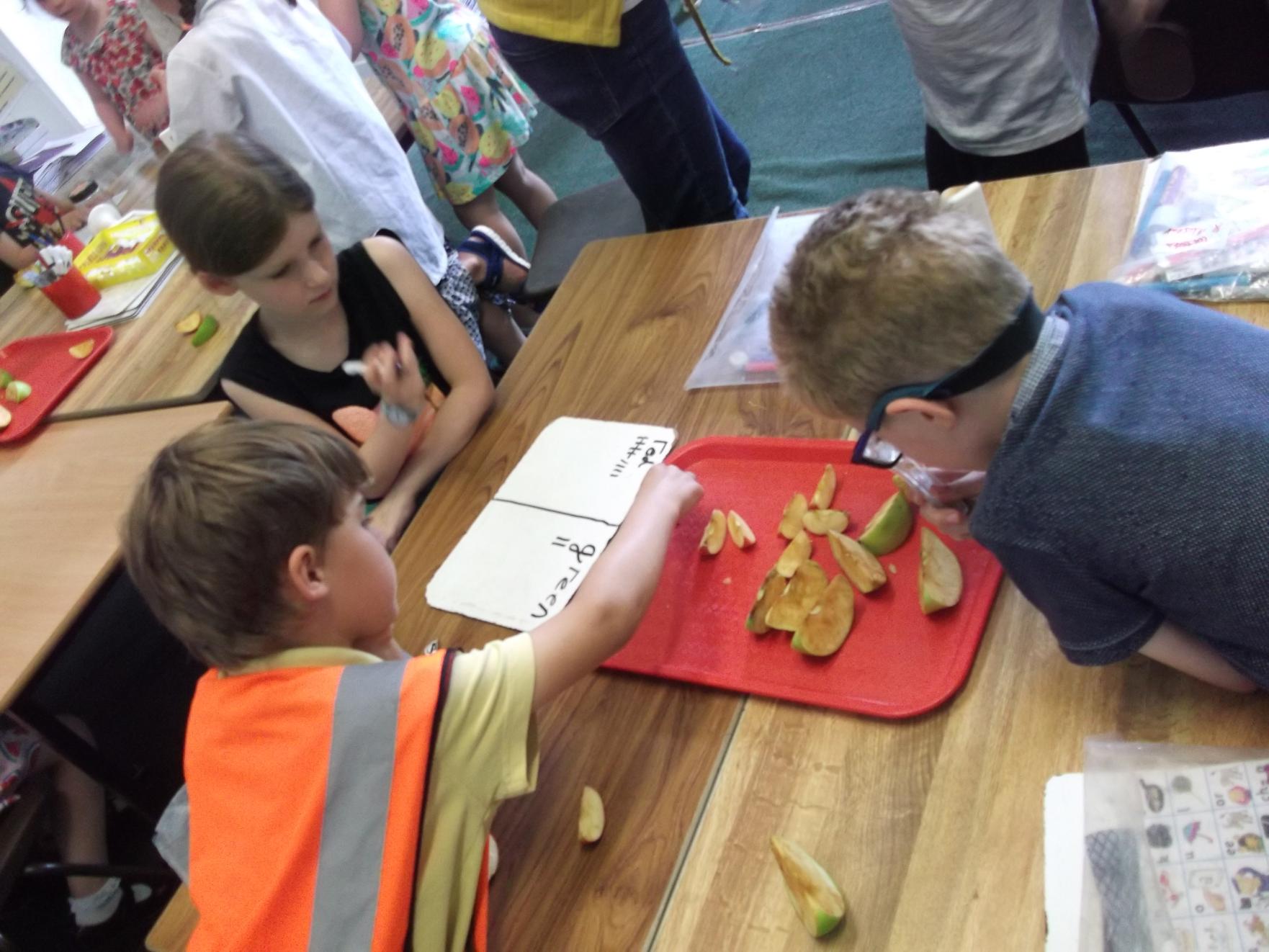
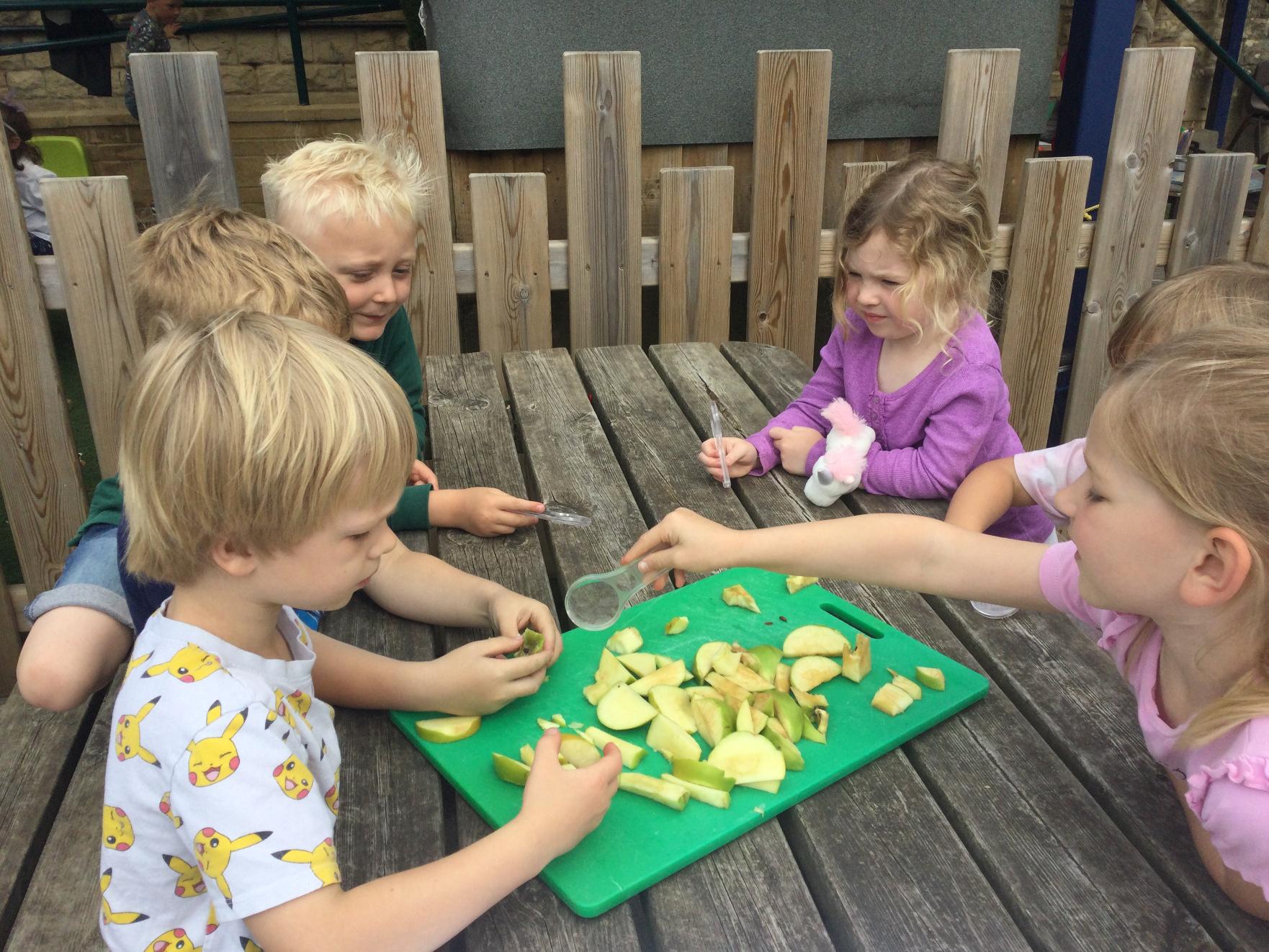
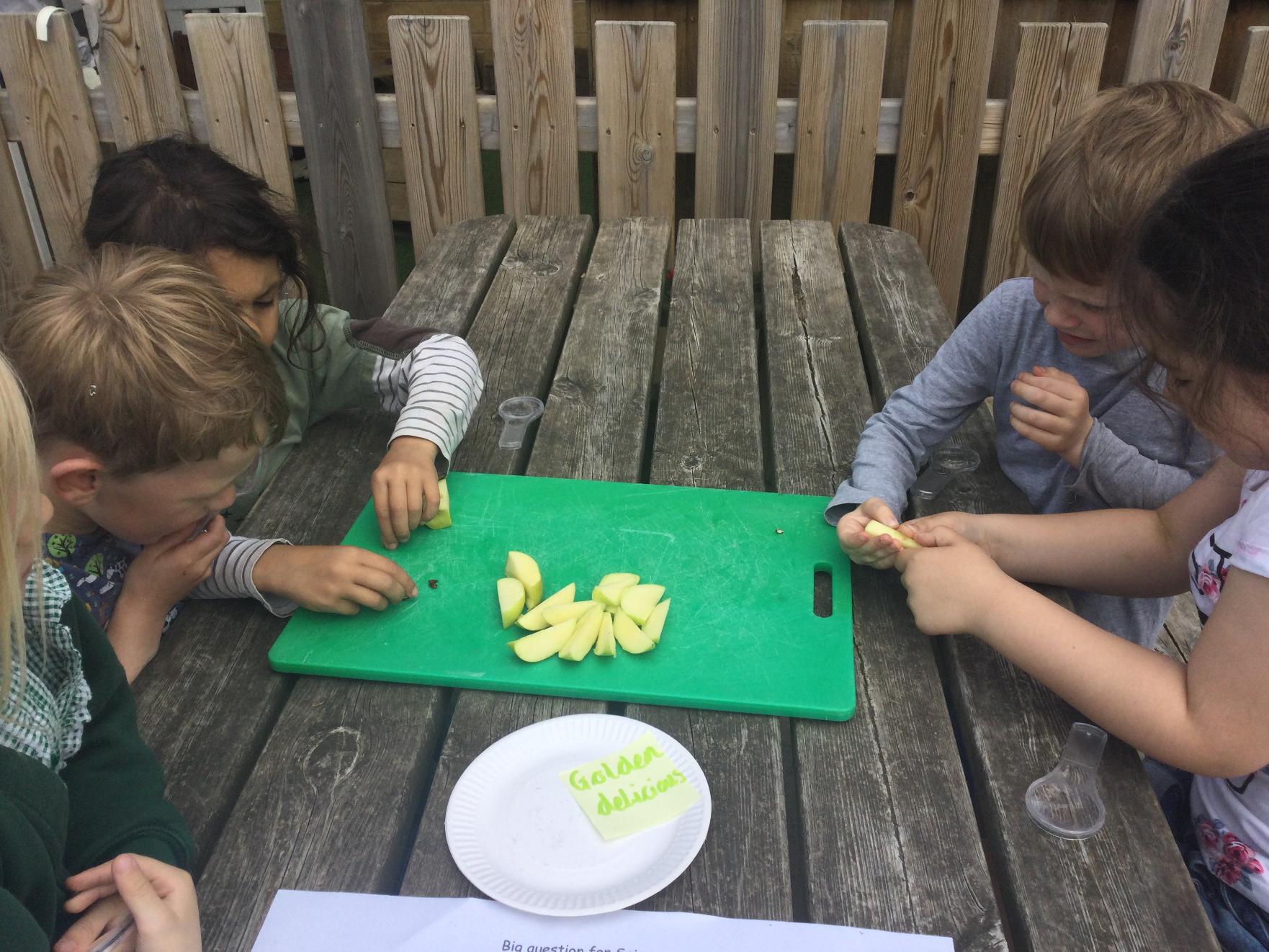
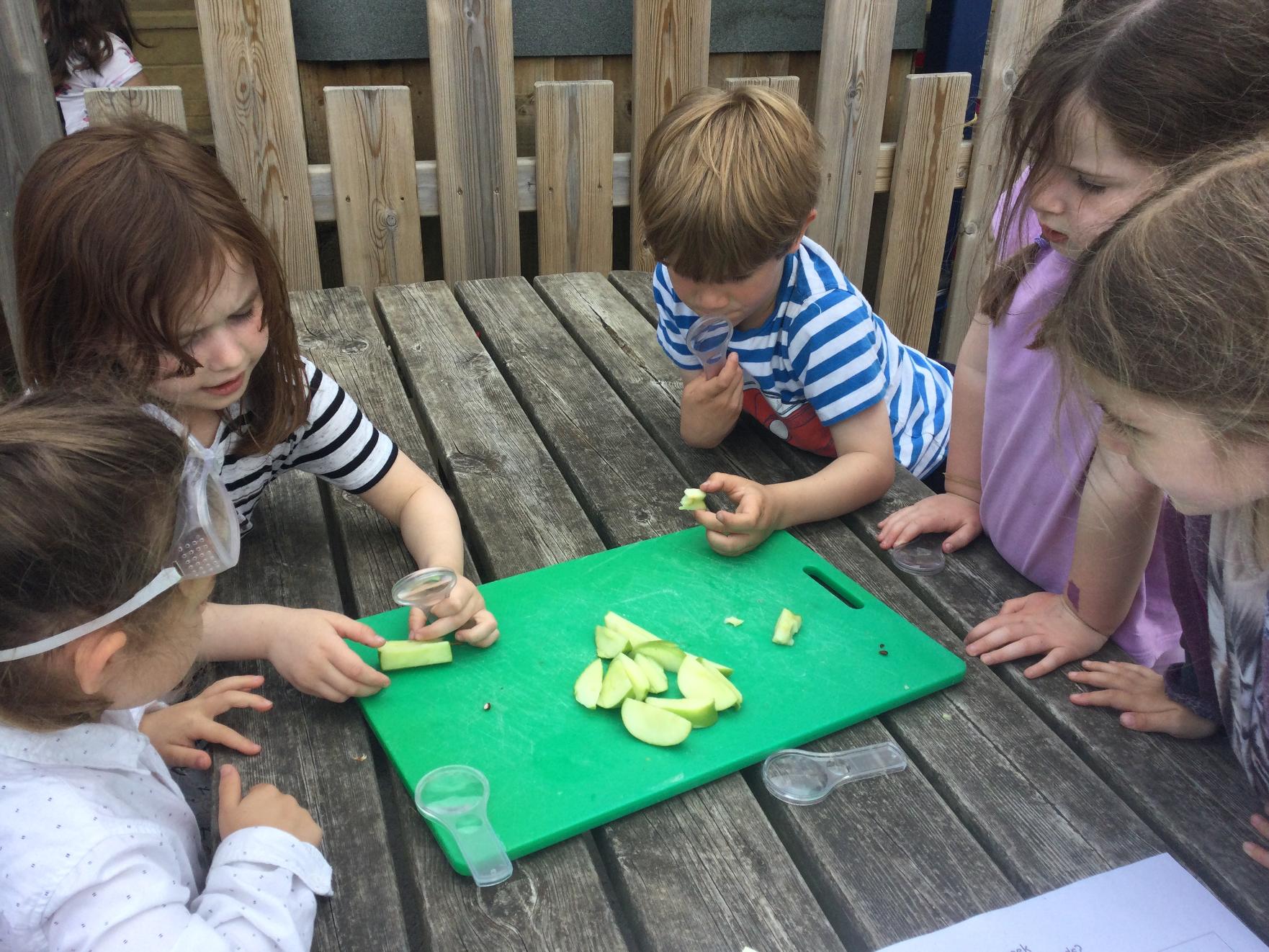
Beech - We were armed with magnifying glasses, microscopes and tweezers to help us investigate today's question about apples. We found that the red apples had a larger number of seeds than the green apples. Afterwards, we wanted to look at the seeds under the microscopes and we were amazed by what we saw close up. Some of us now want to plant our seeds to see if they will grow into more apple trees!
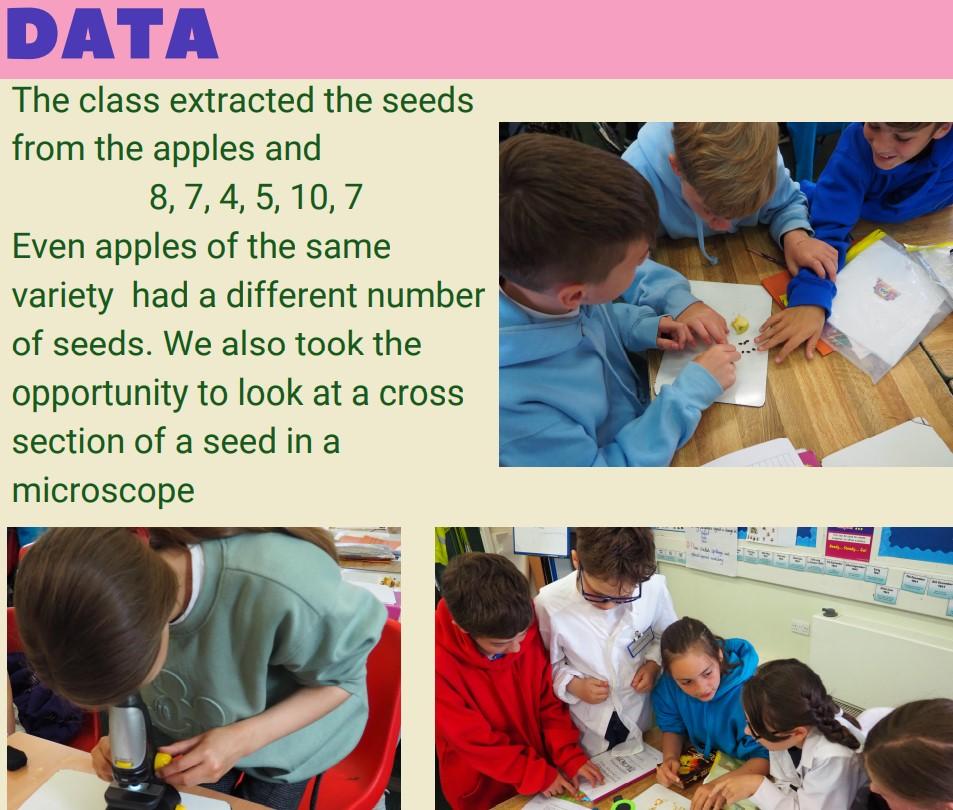
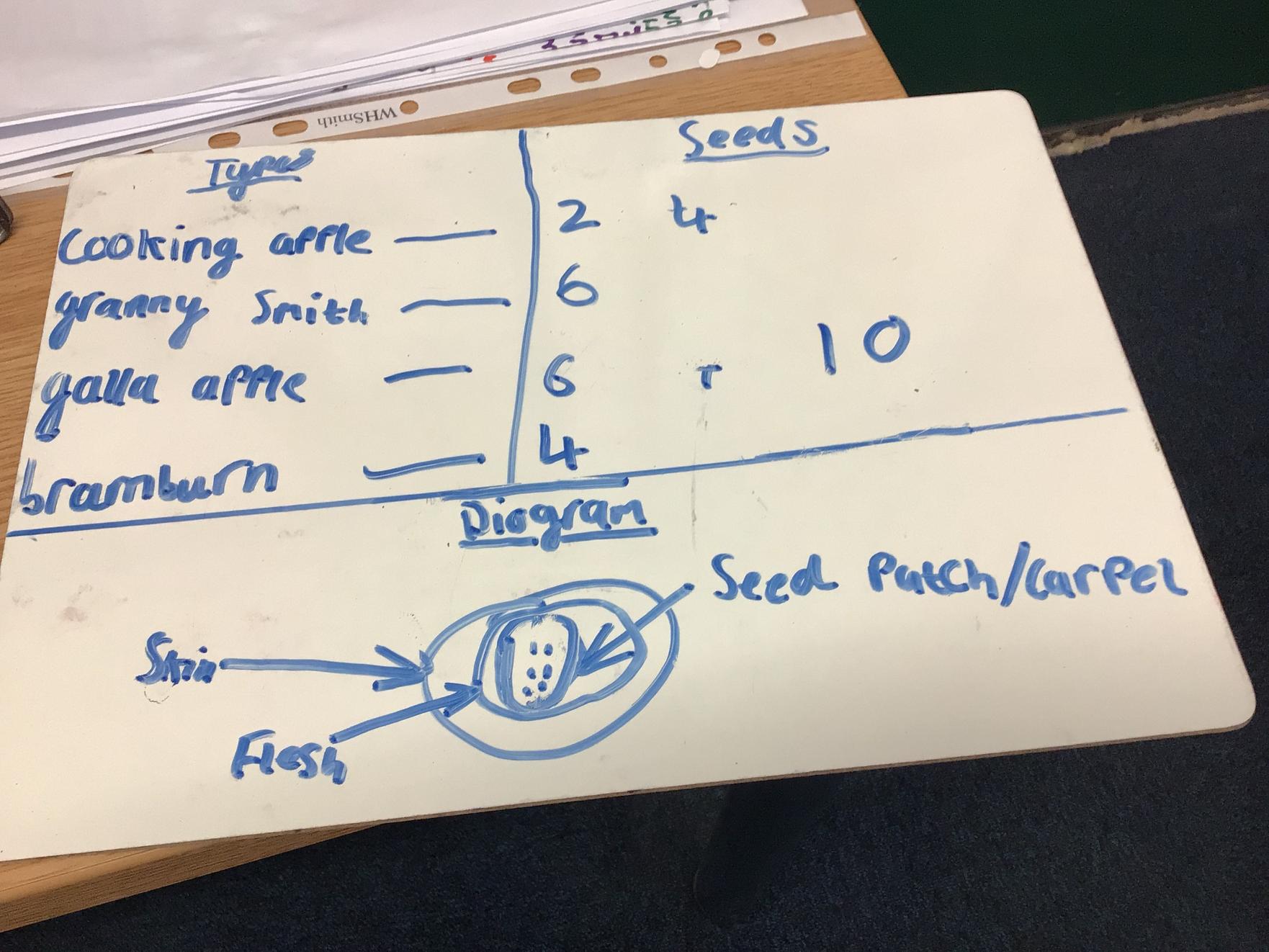
Hawthorn – Armed with magnifying glasses, microscopes and tweezers we decided we were going to look at the outside of the apples first to decide whether they had an impact on the number of seeds. We saw that although we had different apples of the same variety they all looked a bit different. Some were redder, some were bigger and one still had part of the blossom on it. We talked about how the seed is formed and thought that all of the same size apples would have the same number of seeds. We learnt that each apple, regardless of variety, has 5 seed pockets or carpels but that some pockets could have one seed and some could have more. We really enjoyed looking at the seed under the microscope!
Juniper -
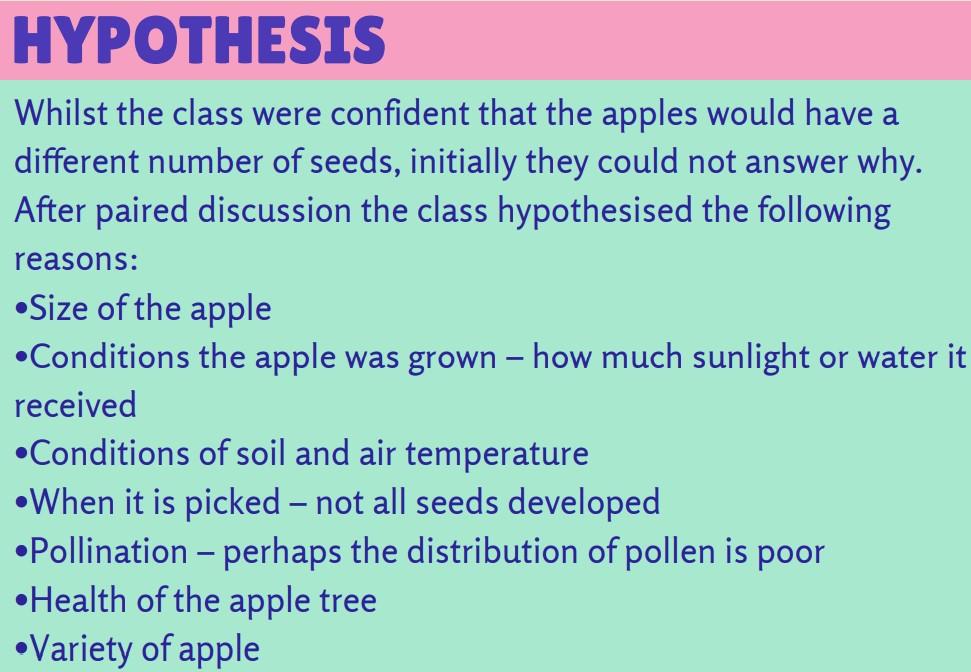
Hypothesis - The class discussed what factors might affect the number of seeds in apples. They decided that apples would have different numbers of seeds depending on the following factors:
- The size of the apple.
- The variety of the apple.
- How much sun it had experienced prior to picking.
- Whether it had been picked from a healthy plant that had good nutrition.
- How early it had been picked, before many seeds had time to develop.
Results
|
Type of apple |
Number of seeds |
|
Cooking apple |
2,4 |
|
Granny Smith |
6 |
|
Gala |
6,7,10 |
|
Braeburn |
4 |
Conclusion - The size of the apple definitely affected the number of seeds and the variety of apple. We also felt that the freshness of the apple and the health of the apple tree it was picked from would also have an influence on the number of seeds
Do all flowers have the same number of petals?
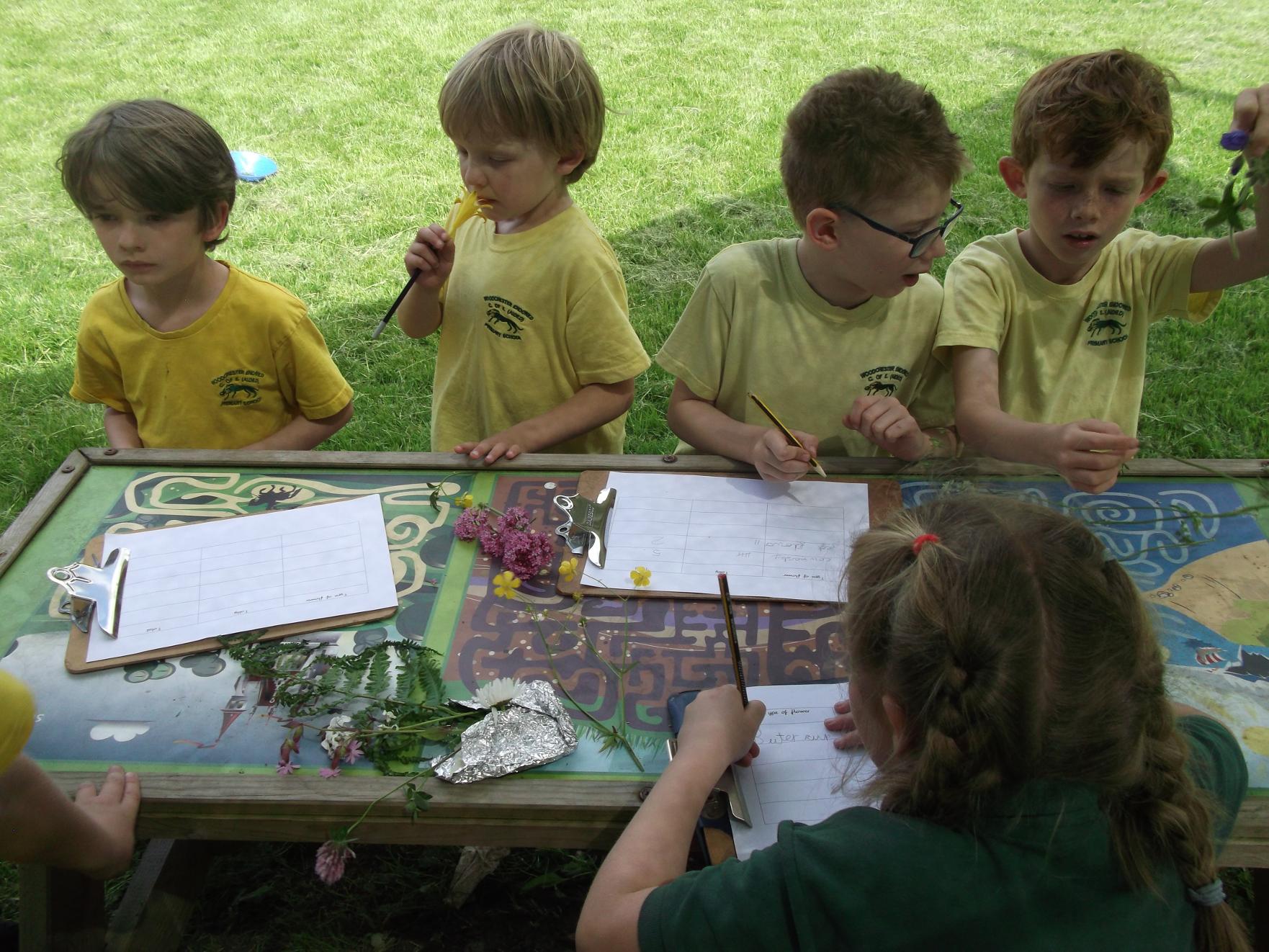
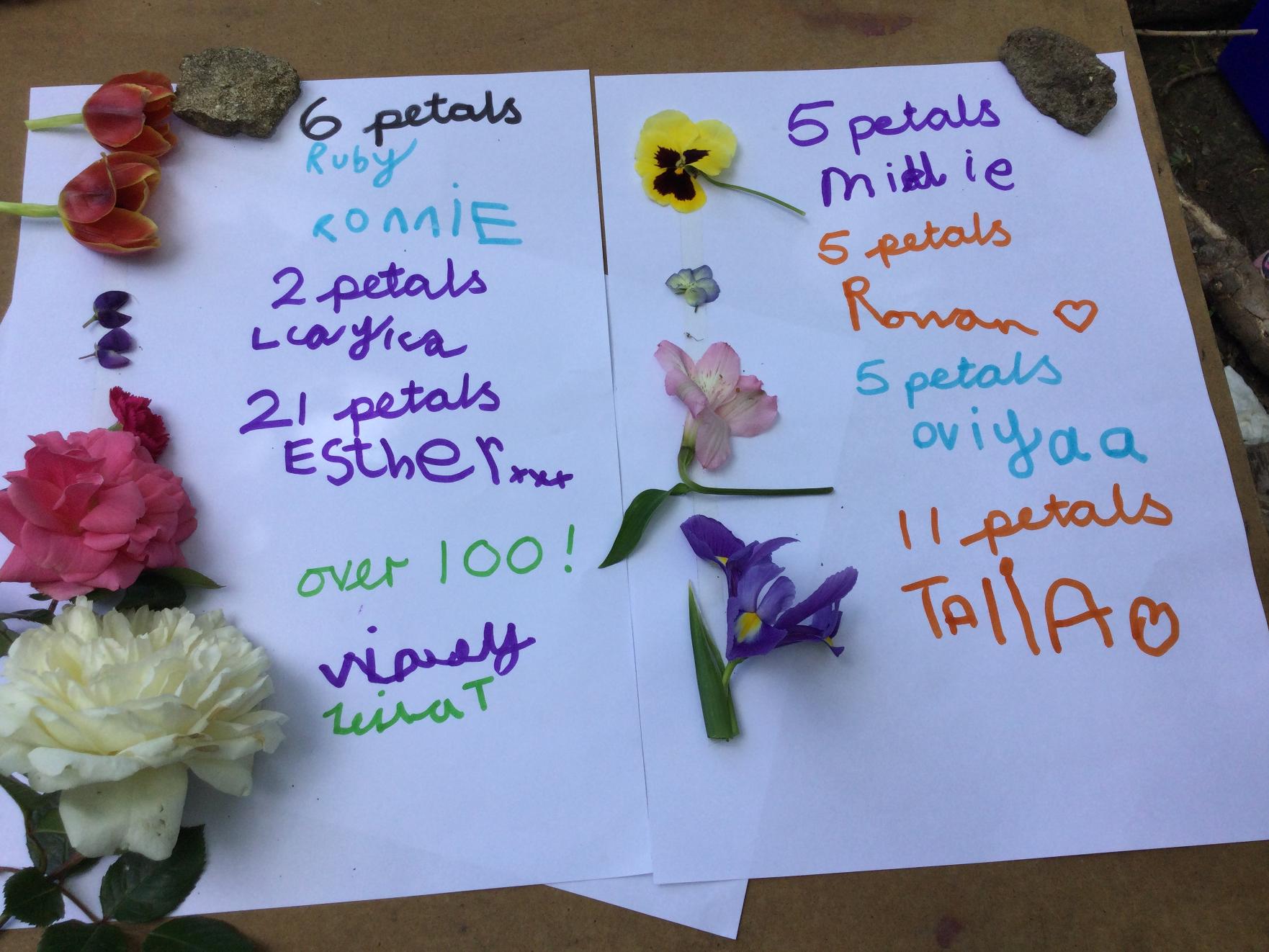
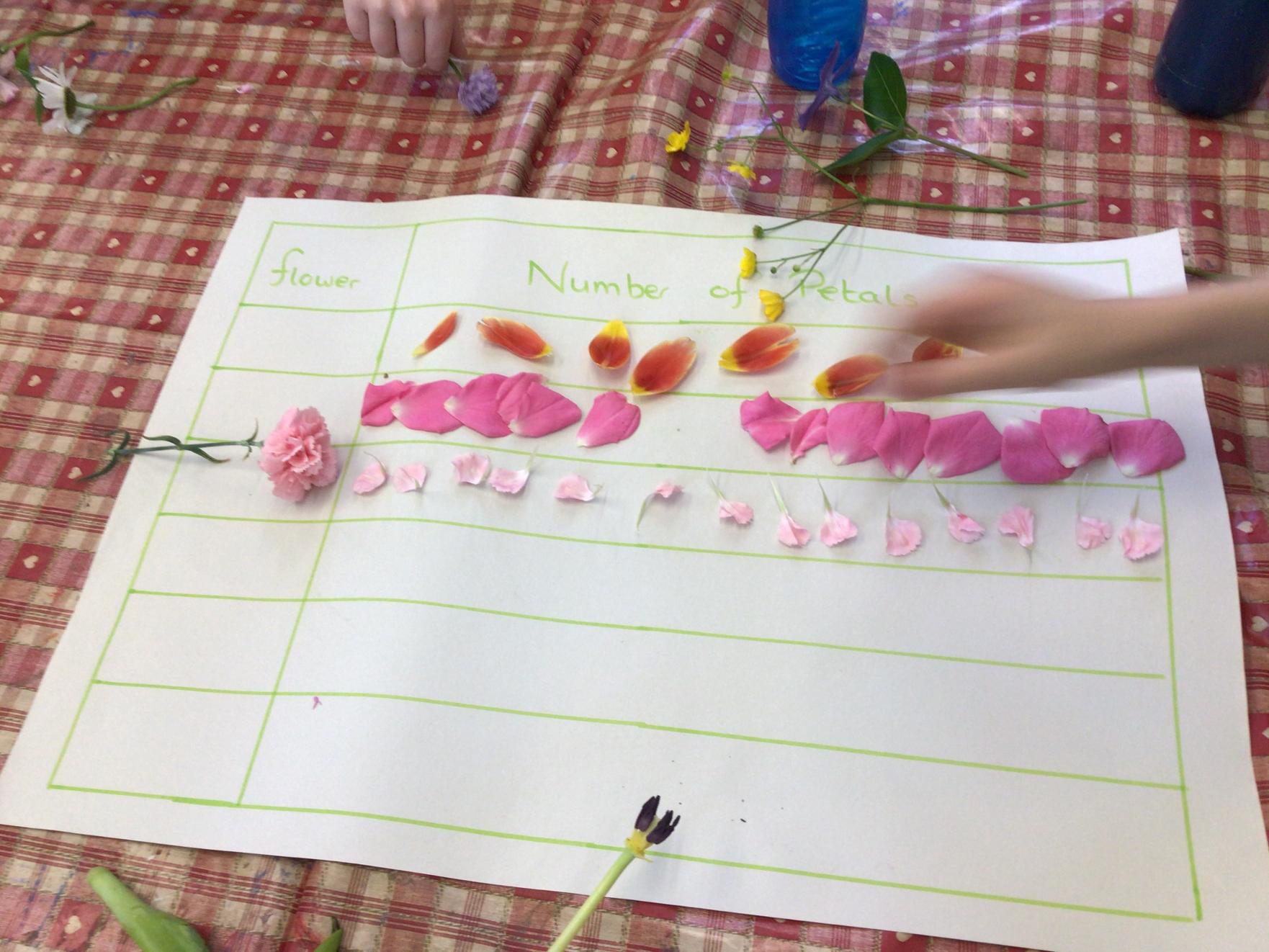
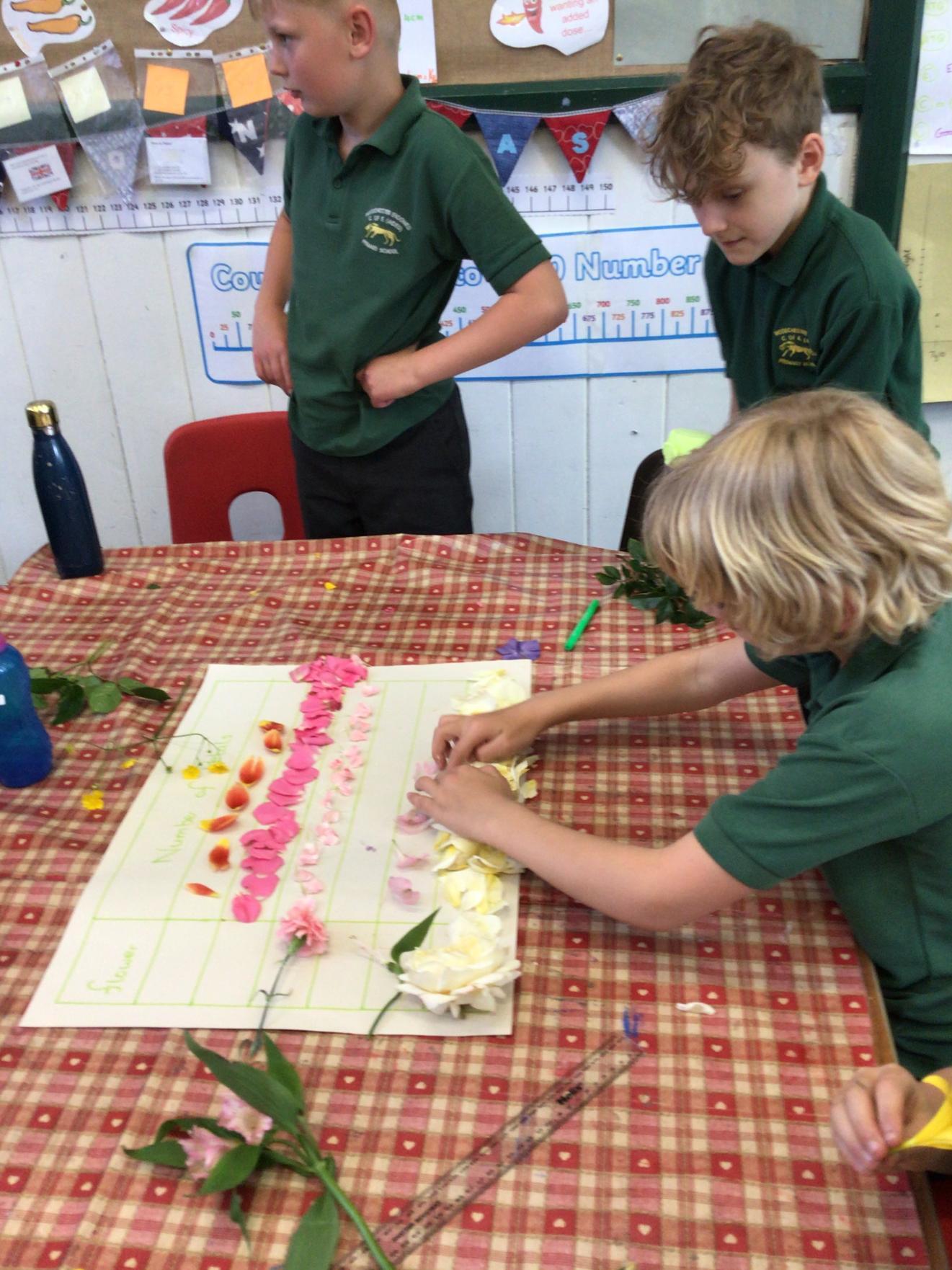
Ash Class - Mrs Holmes asked the big question and the children were all convinced that flowers had a different number of petals. We talked about how we might answer this question and it was decided that everyone would choose one flower and count the petals. We stuck the flower on a sheet of paper and recorded the number of petals and a name. For flowers with a large number of petals, I suggested we estimated (note to self - estimation skills need looking at in Maths!). We looked at the results and worked out that there were several flowers that had 5 or 6 petals but, other than this, we could not form a firm conclusion.
Beech - Before starting the investigation, we predicted that the flowers wouldn't have the same number of petals. We set off on a mission to find out if we were correct. Some of us decided to pick each petal off individually, whereas others decided that they could count them by sight. We recorded our results in a tally chart and found that some flowers had over 100 petals! We thought it was interesting that different types of roses had different numbers of petals.
Hawthorn – We had a huge array of flowers in Hawthorn so started by talking about the differences between some of the flowers, the size, the scent and the shape. We then discussed how we were going to count the petals and decided we would pull the petals off to count. We were quite sad that we had to pull them off! We counted the petals on different flowers with each group taking different flowers and created a tally chart to count the flowers. We then added all of the tallies together to find out how many petals each flower had. We were amazed that roses had over 100 petals but that the pansy had 6. We were also surprised that some larger flowers had less petals than some of the smaller flowers. We also talked about how many different colours of petal we had in the classroom and how the same flowers can have different coloured petals.
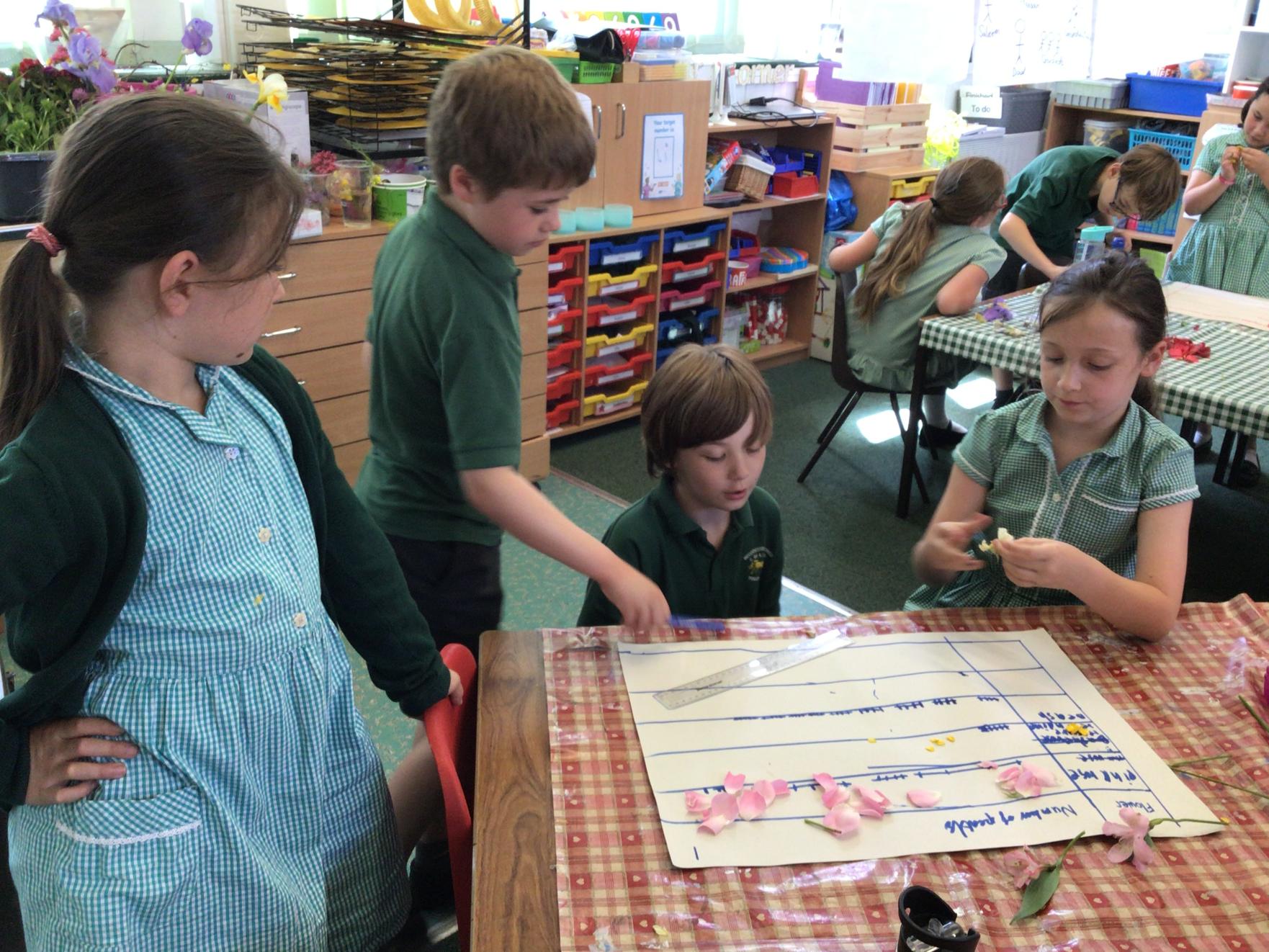
Juniper - We were surprised at the number of petals a small flower like daisy or ragwort had, in comparison to a larger flower like an iris. We counted the petals on different flowers and created tally charts in groups and then made the choice of recording the data in either a bar chart or a pictogram.
This investigation led us to look at the Italian mathematician, Fibonacci and his discovery of the Fibonacci sequence, or ‘Nature’s Code’ as it is sometimes referred to. Within the sequence 0,1,1,2,3,5,8,13,21,34,55,89 ……………we were able to recognise some petal numbers.
Lily 3
Buttercup, hypericum and gladioli 5
Daisy 34 and 55 and even 89 sometimes
These Fibonacci numbers enable each flower to maximise the number of seeds it can grow so that the plant can reproduce and continue indefinitely. Juniper Class wondered whether the fact that flowers like daisies grow everywhere is down to the many petals and seeds they produce.
Willow - The children enjoyed taking the flowers apart and counting the petals. We discussed what constituted a flower/petal, looking at compound flowers and simple flowers. We then explored the relationship between some flowers and Fibonacci’s number.
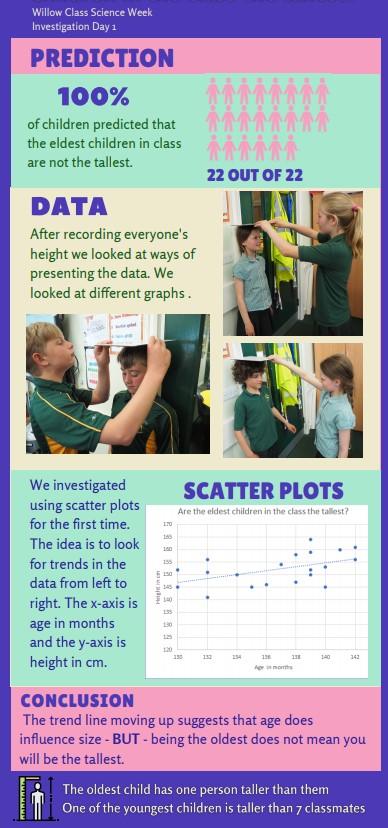
Is the eldest person the tallest?
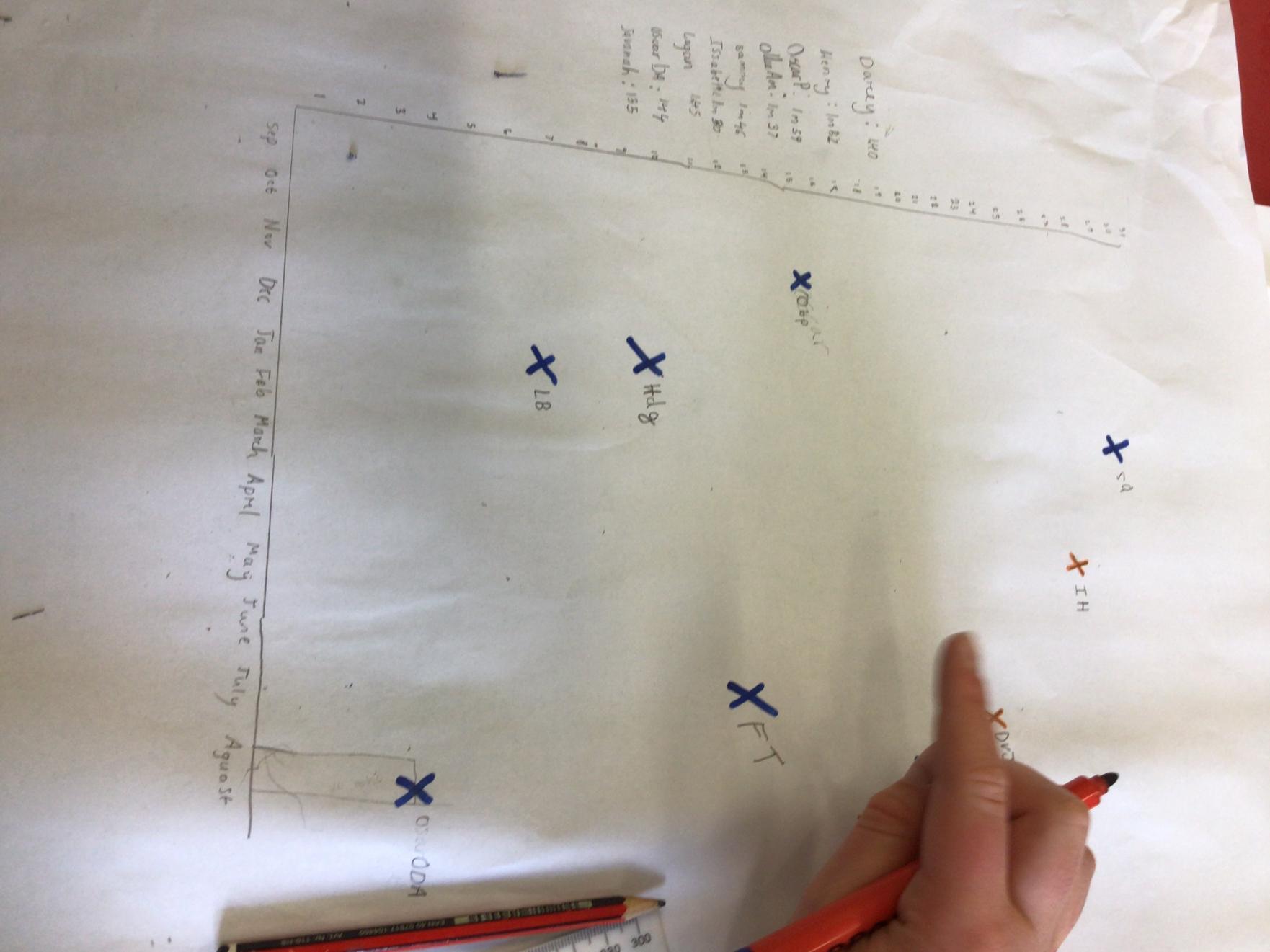
Ash Class - Our discussion started off with ages - we have some 6-, 5- and 4-year-olds. Everyone knew who was the eldest and I then went through the names in order. We talked about the big question, and predicted. Everyone agreed that the eldest child would be tallest, but we were undecided about the shortest member of class. We talked about how we might find out the answer to our question and someone suggested lining everyone up in order. This is what we did, and I marked heights on a piece of paper stuck to the wall. (I felt measuring would have been too high a skill for all of my children). The children sat back and talked about where they were on the sheet of paper. I then asked questions - tallest/shortest/any odd measurements? I joined the dots, and we could see that the line did not follow a downward shape, which is what we expected. We concluded that our eldest member of class was the tallest, but our youngest member of class was not the shortest.
Beech - We measured how tall each person in our class is. We used our knowledge of measurement to help us measure in metres and centimetres. We found out that although a lot of the older children in our class were taller, it wasn't strictly true that if you're older, you're always taller.
Hawthorn – In Hawthorn, we talked about what being the tallest meant – we did a vote for our prediction where most of the class thought that no, being the eldest did not mean you were the tallest. We then lined up in height order and we found that most of the Year 4 children were taller than some of the Year 3 children but not all.
We then measured ourselves in groups and worked out our birthdays to decide who was the eldest. In some groups, the children who were the tallest were the eldest but this was not the case when we looked at the results across the whole class. We discovered there was no link as the oldest in our class was not the tallest.
Juniper - Our prediction was that older children could be taller because they are more developed. However, this is not necessarily the case, because children develop at different rates. Girls tend to be taller at first, but stop growing before boys have reached their full height.
We measured everyone in our class, and recorded the month of their birth and height.
We discovered there was no link as the oldest in our class was one of the shortest.
Willow Class Investigations